

How safe is car racing?
If anyone has ever watched any car racing event, they would have surely also seen a car crash. Car crashes can occur as a result of one or more of three primary causes: driver error, mechanical/component failure, or contact with another race car. Bear in mind that all these are happening when the car/s are travelling at an average speed of 200kph (or 125mph). So, a split second of a good/bad decision is all it takes for a drastically different race outcome.

Over the years, increased safety measures taken by governing bodies and improvements in technologies have significantly reduced the number of injuries and even deaths. In Formula 1 racing, that includes things like having fire-resistant suits, having a survival cell (or ‘Monocoque’), neutralising dangerous corners, Carbon fiber helmets, the Head and Neck Support device (HANS), the Halo device, fire protection gloves, etc. Notable decreases in injuries (from 1950 to 2024) were seen in fractures, upper extremity injuries, and lower extremity injuries. Though at the same time, the number of back/spine, neck, and pelvis/sacrum injuries has remained consistent. [study link].

One of the key contributors to the decrease in injuries has been the HANS device and the mandatory use of it since 2001. Developed by Professor Rob Hubbard of Michigan State University’s biomechanical engineering department, the HANS device was proven to reduce the flexion-distraction force on the head and neck by 80%. While it is clear that the HANS performs well in frontal head restraints (FHR), it provides little to no protection in side/angled impacts. Depending on the crash, it also does not reduce the effects of vertical forces (compressing the spine) or horizontal G-forces on the body. The HANS collar could also cause bruising around the collarbone after wearing it. There are hybrid versions of the HANS device that try to address a couple of these limitations. However, it still leaves people wanting.
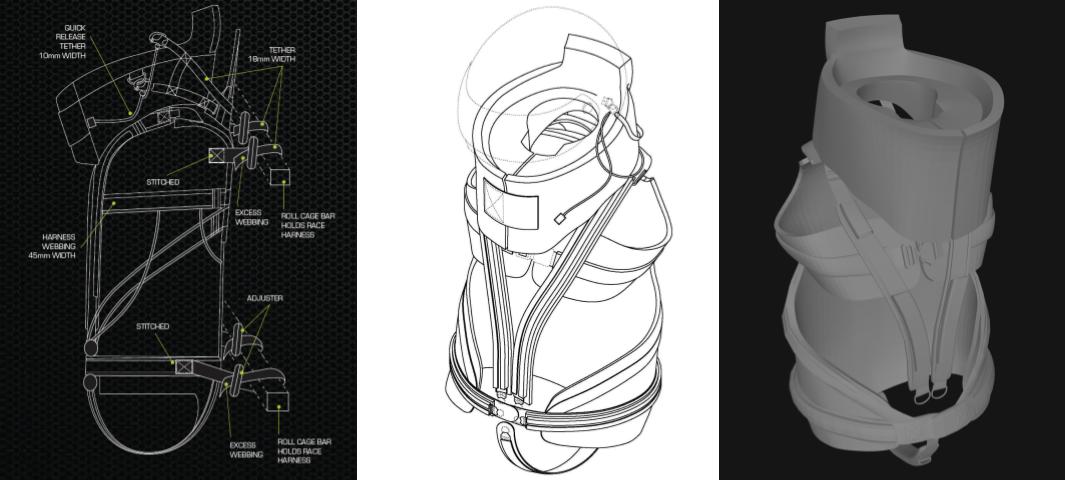
Not happy with the state of the solution, Mackz Performance has made it its mission to ensure that every race car driver can walk out of a crash without life-threatening injuries. After spending over twenty years designing and testing, working closely with experts, and getting user feedback, the Mackz team has finally developed the Mackz 360 SCS (Safety Cell System). This innovative system provides 360° coverage, mitigating impacts not only from the front but also from above, below, lateral, and, critically, rotational forces. These are areas where current solutions, such as the HANS devices, show severe limitations.
The Mackz Difference
What sets the Mackz 360 SCS apart is that, unlike traditional neck restraint systems focused on frontal deceleration, the Mackz system was designed with full-body biomechanics in mind. Firstly, it stabilises the helmet across X, Y and Z axes, providing Basal Skull protection in all directions. The implication of that is huge, including preventing eye nerve injuries that have a severe impact on a driver’s vision. [Check out this video of Tyler Courtney talking about his head trauma that led to his nerve injury – video and the video below of the actual crash.
Secondly, the Mackz 360 SCS distributes impact energy across shoulders, back and torso, offering spinal support and organ cushioning utilising high-density, fire-retardant foam. Also, it incorporates fire and fume shielding beneath the helmet, a feature not seen in any other product on the market. On top of all that, it is designed with the driver’s ‘safety workflow’ in mind, allowing them to release themselves from the seat and exit their vehicle in just 10 seconds in the event of a crash.

Tom Weisenbach, Executive Director of the International Council of Motorsport Sciences (ICMS), touts that ~ ” this device is what motorsport has been waiting 18 years for“.

How it all started

Back in 1996, Paul Cleveland (founder of Mackz Performance) was racing at Redline Speedway, Ballarat. He was coming onto the main straight in second place and turned the first place into the wall. He planted his foot and entered the infield, and unfortunately, the leader came out of the dust and also got through the infield. Paul quickly locked wheel to the left and took the whole back of his car off right behind his roll cage. When the medics got to him, they could not find his helmet as it was trapped behind his shoulders. It took them 2 hours to cut him out of the car, and he was not breathing for 10 minutes. He was revived twice, put in a coma and woke up 30 hours later. After many, many weeks in the hospital, Paul had a dream of the accident, and that’s when he came up with the idea of a foam neck device – something that would give better protection to a driver. He started cutting up foam in his home, and later on, got help from a mattress maker and had a properly designed neck brace. From the get-go, Paul began putting his foam neck devices on race car drivers, and the feedback was positive.

Becoming Mackz 360
Fast forward to the 2010s, Paul started to design a body harness / safety cell system, becauase he felt the neck brace was incomplete. However, the harness design in the early stages missed the mark slightly in the SFI Specification 38.1 Sled test for Head and Neck Restraint Systems. Still, test results showed that the foam absorbs impact really well. Add to that, when he spoke to potential investors, they were only interested in a basic neck device. So the safety cell system concept was put on the back burner till the stars aligned and they found the right design engineer and manufacturing experts, which allowed Paul’s vision to come into fruition.

This whole journey of developing the Mackz 360 SCS was not entirely about the physical product creation. It was also about truly understanding the entire ecosystem of racing, from the supply chain of safety equipment across racing codes, to medical science and standards, regulators and even the minds of racers. Part of that journey involved rebranding (Brase yourself -> Mackz Performance) and repositioning the solution beyond simply a neck brace, and into a more comprehensive safety cell system (SCS).
IP, Research Validation and Beyond
In the last couple of years, Paul reformed the leadership team with initial funding and developed a strategic plan to bring Mackz 360 SCS to the world of racing, spanning from Formula 1 to grassroots racing. The team has put basic IP protection in place for their design, and they are taking crucial steps towards engineering and medical validation. By partnering with Swinburne University of Technology, the plan is to perform full sled simulation testing and further biomechanical testing to validate the 360° safety system. The results will inform any revisions required for the final prototype, which would then undergo the FIA-standard SF38.1 sled testing, material burn testing and other critical compliance checks necessary for international certification and approval. These approvals would be the final hurdle before Mackz 360 SCS is released into the world.

Beyond motorsport safety, Paul has envisioned that this safety system could have broader applications in military applications, aviation, and specific contact sports.
Opportunity to invest
There is currently an opportunity for investors who have an interest in motorsports to be part of the exciting final steps of development. The Mackz Performance team is seeking funding to cover research, testing, and the final design and development costs. If you would like to have a stake in the future of motorsports safety, you can reach out to the Mackz team here – link. First in best dressed.
 Sports Technology Blog